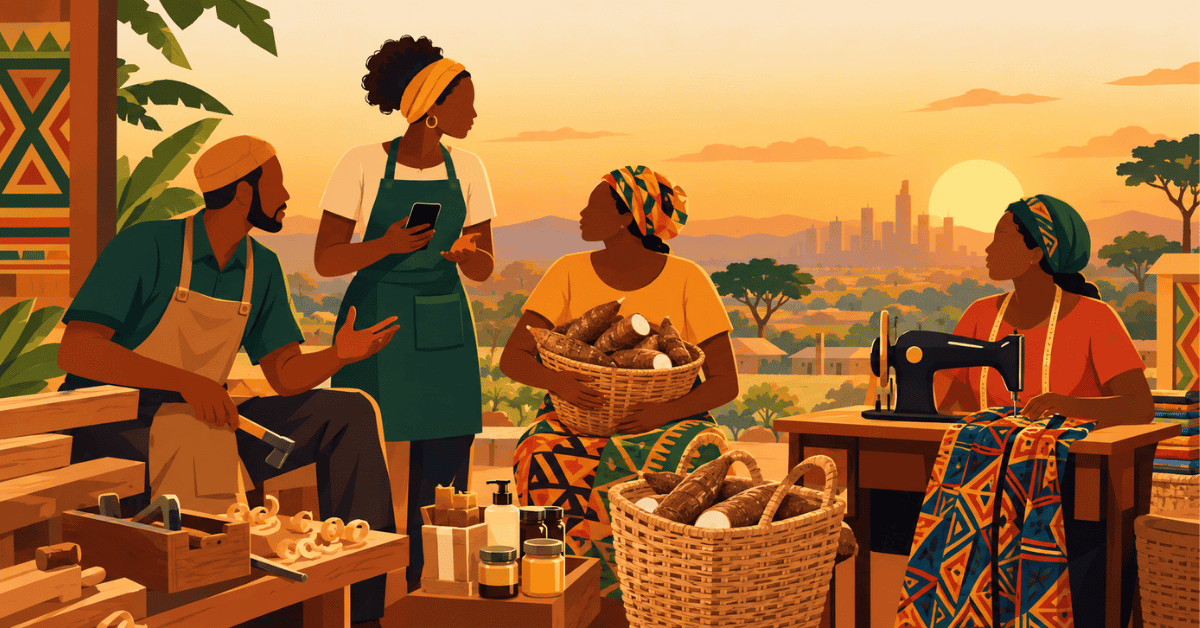

Four founders, two gatherings, and the people who stood behind them.
No founder builds a business alone. Behind the person testing an idea, hiring a first employee, or learning to read a cash-flow statement, there is usually someone who offered something before anyone knew how it would turn out: knowledge, an introduction, a little money, or simply time.
Last week we brought some of those people together with four of the founders they have helped. On October 22 and 24, our board, country leads, donors, mentors, volunteers, and friends joined us online for two short gatherings. We weren’t there to ask for anything. We wanted to say thank you, and to let the founders explain in their own words what that support has meant.
After a welcome from our board (Dr. Olalekan Sowade on Thursday, and our board chair, Steve Breban, on Saturday), we played a one-minute video in which founders spoke directly to the people on the call. One described doing business “blind” before the program. Another talked about the grant his business had won. Another said they had been coming out of a very dark time, and that the support they found here is the only reason they are still pursuing their venture. The video ended with a line that became the theme of both gatherings:
“Every founder you just heard had people like you in their corner. You are part of their story.”
If you weren’t able to join us, we’d love for you to watch the Thank-You video. It’s a minute long, and it says what we’re trying to say better than we can.
In Their Own Words
Two founders joined us live at each gathering. Chudi asked each of them what they were doing before, what their business is today, what has changed, and what they would like to say to the people who supported them.
Ali Issah, Ghana
Ali, an FRP-02 alumnus, was already farming cassava and had put up a factory building when he found Africa 2100, but he didn’t yet have the equipment to start processing. Today the business turns cassava into several kinds of gari. It buys from smallholder farmers in his community, who now know they have a market before they plant, and sells to local retailers. It employs about 10 people permanently and about 20 casually, plus seasonal hands on the farm. Put together, Ali said, the business is changing the lives of “not less than 200 people” in his community.
Before the program he tracked income and expenses and little else. Through the mentorship he learned to prepare his own income statement and cash flow and to balance his books, which he said gives him the confidence to stand before any investor. His business has won a $15,000 grant, and he is waiting to hear about roughly $10,000 more from a Government of Ghana program.
He was candid about what is still in his way. A larger company he hopes to supply inspected his factory and told him it wasn’t yet up to standard. Before he can sign that kind of contract, he needs a warehouse and an upgraded facility, and the business can’t pay for them on its own in any reasonable time. Better books make him a stronger candidate for that capital, but he still has to raise it.
Angela Wakanyi, Kenya
Angela is a final-year computer science student, a member of FRP-03, and part of our Arise Campus Chapter program. She found us through a poster someone shared on their WhatsApp status. She is building a women’s intimate-wear brand, starting with biker-short-style underwear designed to prevent chafing.
The program changed the order in which she thinks. She used to start with a solution; now she starts with the problem and the people who have it, a habit she said has helped her schoolwork as much as her venture. It also changed how she thinks about money. She had always told herself she couldn’t start a business without capital, but capital spent on a solution that doesn’t address a real problem is wasted. “Capital is the last thing you need to worry about,” she said. Her business is still at an early stage, and she said so.
Migire Ouma, Kenya
Migire, an FRP-02 alumnus, buys furniture that has been abandoned around his community, refurbishes it, and sells it at prices his neighbors can afford. Before Africa 2100, he said, he was running the business “for the purpose of hand to mouth,” and couldn’t tell whether he was making a profit or a loss.
He now keeps records every month and knows where the business stands. When he started he had one carpenter and one laborer; today eight people work for him. The business pays his children’s school fees and helps his brothers with theirs. “When I wake, I feel that I’m very, very secure,” he said, and he meant it for his employees and the people who depend on them as well as for himself.
Edith Joseph, Nigeria
Edith, an FRP-02 alumna, runs a healthy-living food brand for people living with diabetes. Before the program, some customers paid into her personal account and others into the business account, so she couldn’t say with confidence what the business was earning. Separating the two was the first thing she changed.
Since then her products have been trademarked, she has a space where customers can walk in and buy them, and she has started partnering with gyms. She is now developing snacks for people who have been told to avoid sugar but have little to eat in its place. Having an idea is one thing, she told supporters, and having someone hold your hand while you work out how to make it succeed is another.
Where FRP-03 Stands
Chudi also shared where the current Foundation Readiness Program cohort stands. This spring, 224 people applied from up to 20 African countries, well beyond Ghana, Kenya, and Nigeria, where we started. Of those, 139 completed the screening interview in the Arise app, and we invited all 139 to join, partly to test how well the new screening algorithm predicts who will go the distance. So far 24 have activated their place, through scholarships funded by your donations and your time. In a baseline survey, 13 of the 24 said this was their first entrepreneurship training, and 12 already had a business under way.
Ten founders have now completed Validate, the first stage, where they test whether the problem they want to solve is real and who experiences it. Three have moved on to the second stage, Build.
We track each of those steps separately because an invitation, an activation, and a finished stage are not the same as a business moving forward. The program is self-paced by design. We provide structure, mentorship, and follow-up, but each founder has to choose to keep going. Chudi was also open about what makes steady progress hard: the side businesses most founders depend on to put food on the table, the cost of mobile data and unreliable internet, and the resilience and discipline the work demands, which not everyone who starts will have. We have moved to a monthly intake, and we keep following up with invited candidates who haven’t activated to find out what is stopping them.
Paying It Forward
FRP is free to founders. Instead of a fee, we ask them to commit that, once their business is viable, they will help sponsor two or three people like them through the program.
Most aren’t there yet. What has surprised Chudi is that many alumni aren’t waiting. They are already coming back as volunteers, mentors, and accountability partners for the students in our Arise Campus Chapter program, helping to build the kind of community they needed when they started.
Two of them spoke on Saturday. Cathy stays involved, she said, because entrepreneurship needs a community, and because the learning runs both ways: “I’m still learning from my mentee.” Isaac Newton, an FRP-01 alumnus in Ghana who finished the program more than a year ago, said the community has connected him with founders in other countries he would never otherwise have met, and that the students he mentors have as much to teach him as he has to teach them. “Entrepreneurship is, or can be, a very lonely road,” he said. A community like this one means you don’t feel alone on it. He added that he sometimes wonders whether Chudi ever sleeps.
Our country leads carry much of this support on the ground. Dr. Beryl Ehondor, our Nigeria Country Lead, closed Saturday’s discussion with advice for founders: stay adaptable, learn to build relationships, and look after yourself. “When you are down,” she said, “talk to someone. That’s why we have a strong community.” Chudi thanked her, along with Cassandra and Lillian, who lead our work in Ghana and Kenya.
More Than Money
Supporters’ questions ran both gatherings past the planned 45 minutes. One exchange stayed with us.
A long-time supporter described how, after last year’s showcase, he asked about eight friends to each give part of their annual coffee budget and raised about $6,000 to back a founder. That investment didn’t go ahead. He asked whether we had encouraged other small groups to try the same thing, and pointed out that a group like his brings more than money: financial planning skills, export contacts, and networks abroad.
Chudi agreed that this is often what founders need most. He also explained what we learned from that attempt. Due diligence on that one investment took about three months, while most founders need somewhere between a few hundred and a couple of thousand dollars to reach their next milestone. For amounts that size, we’re working toward a milestone-based micro-loan approach, where support unlocks as founders show progress, such as landing a first customer. Even then, founders will need people who can help them put the money to good use.
Thank You
Chudi closed both gatherings the same way. He tells founders in our community that he is “selfishly using” each of them, because a founder’s success doesn’t stop with them. Their confidence grows, their families are better off, and their communities see more commercial activity.
None of that happens without the people who joined us last week and the many who couldn’t. To our board, our country leads, our donors, our mentors and volunteers, and the alumni who keep coming back: you are the village it takes. You believed in these founders before anyone could say how it would turn out. Thank you.
If you missed the gatherings, please take a minute to watch the Thank-You video. And if you’d like to be part of a founder’s story yourself, write to us at he***@********00.org. You could mentor a founder or a student ambassador, share expertise in finance, law, manufacturing, or regulation, introduce a founder to a potential buyer or supplier, or simply talk with someone about what you learned building your own business. Often one conversation or one introduction is what moves a founder to the next step.
Join the movement-follow us