
What founders told us about what changed, and what hasn’t.
Organizations like ours usually explain their own impact. We report launch rates and job counts, and we tell the stories we’ve chosen to tell. For our September webinar we tried something different. We didn’t bring in an outside expert. We gave the microphone to the community.
Founders from Ghana, Kenya, Nigeria, and Zimbabwe talked about what they’re building, what has changed, what is still hard, and what they hope their businesses will look like five years from now. What we heard was more useful to us than any impact presentation we could have put together ourselves.
Dr. Beryl Ehondor, CEO of Beryl Consults, and our Nigeria Country Lead, hosted. She kept asking people to turn their cameras on: “Don’t hide your glory.” For the next ninety minutes, the founders did most of the talking. One of them was calling from a construction site. Another had just finished delivering an order to a customer.
What People Are Building
The ventures were as varied as you’d expect from four countries.
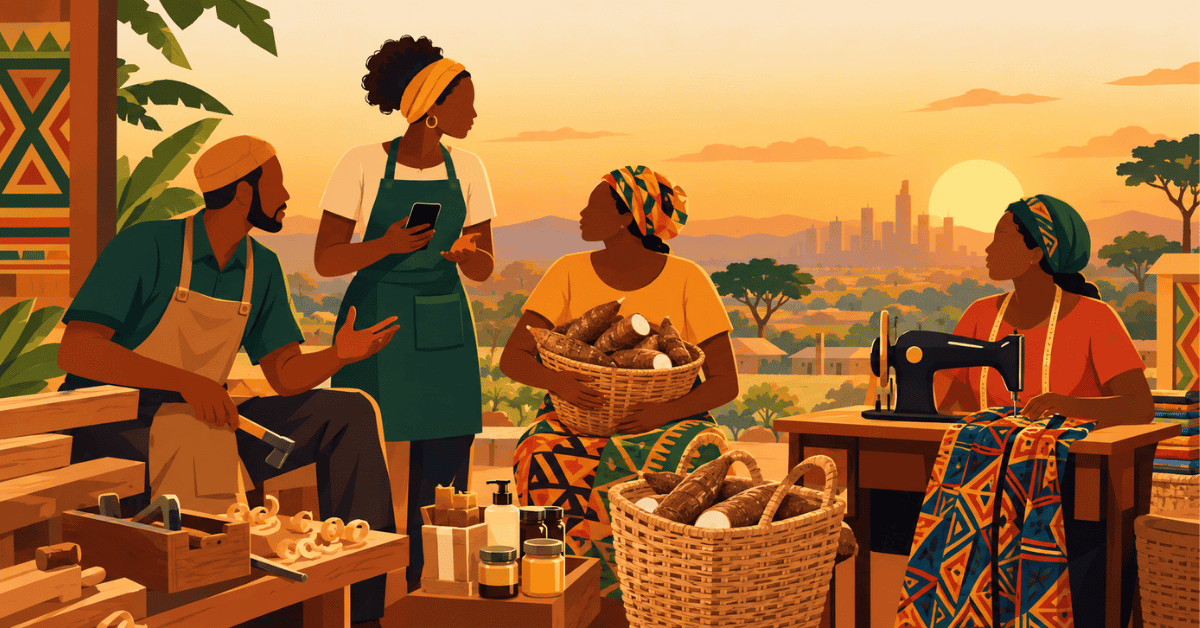
Migire Ouma is a carpenter in Voi, Kenya. He started his business in 2022 after noticing how much discarded furniture was piling up around him, and he refurbishes it into pieces his neighbors can afford. Amon Mukupa (FRP-03, Zimbabwe) is building a platform that connects households with vetted plumbers, electricians, and carpenters. It includes an AI feature that lets a customer photograph a problem at midnight when they can’t describe it. Faith Umoh of Festy Clean Homes Ventures in Nigeria makes eco-friendly liquid detergent and car wash. Ali Issah in Kumasi, Ghana, processes cassava into gari. Edith Joseph is building a Nigerian food brand for people managing diabetes, based on natural African foods. Angela Wakanyi in Kenya is redesigning women’s underwear for comfort.
Beryl also asked each country what had changed recently in its business climate. The participants’ answers were more hopeful than the usual complaints about government. Ali said Ghana’s currency, after a difficult stretch, is now one of the best-performing on the continent. He also pointed to the government’s Adwumawura programme for founders and to a tax break he said agro-processors can apply for. Faith said youth grants and mentorship in her state are posted on the Commissioner for Youth Development’s social media page for anyone paying attention. Angela mentioned Kenya’s Hustler Fund. She was more interested, though, in young people selling on TikTok and Instagram instead of waiting until they can afford a shop.
Then Beryl asked the question that changed the conversation: What did you learn here that surprised you?
“I Was Doing Business Blind”
That was how Migire described himself before joining Africa 2100. He sold to whoever walked through the door and had no clear sense of why a customer would choose him over the carpenter down the road. The answers to Beryl’s question came from different businesses in different countries, but the changes people described were surprisingly similar.
Seeing the customer
Migire said the modules “opened my eyes,” and that the one on value proposition changed his business most. He began offering distinctive decoration styles and additional services, and customers started telling him they had never seen anything like it. He also identified four customer groups: college students, government employees, self-employed people, and low-income households. He now offers each group a product suited to where they are.
Amon had assumed entrepreneurship was mainly about making money. The program moved his attention to the problem and to the person who has it. He came to his platform idea through his own trade, where the jobs are scarce even though everyone needs the services.
Washington, a computer science student in Kenya, disagreed with the usual explanation for why tech graduates can’t find work, which is that they lack skills. His view now is that you can have all the skills you need and still build something that fails if you never ask the people you’re building for what they are actually struggling with.
Running the business
Edith was candid about her investor pitch, where her figures “gave me so much problem.” She now keeps her business and personal money in separate accounts. She also said the pitch changed how she talks to funders: “What is not existing in your business, don’t make it like it’s existing. Share your struggles the way it is.” In the end she took a different route and turned to a family friend for support, using an idea she picked up in mentorship about people who might trust you with their money. Since then her business has secured a space and trademarked its product. The next step is NAFDAC certification.
Ali’s story was the one people kept coming back to. Before Africa 2100, he said, he tracked income and expenses and not much else. Today he prepares his own profit and loss statement, cash flow statement, and balance sheet, and closes his books at the end of each year. “In the beginning, it wasn’t easy,” he said. This year his business won a $15,000 grant, and he is in the process for roughly $10,000 more from the Government of Ghana. He tied both directly to being able to account for every cedi.
“I don’t have [fear] when somebody is giving me money, because I know I can account for it.” — Ali Issah
That sentence says a lot about what we’re trying to build. Talent was never what these founders were missing. What they were missing was the kind of record-keeping that lets someone else trust them with money. Ali now has that, and funders have responded.
He also got something else from the program. Through our Buddy Program he was paired with Lillian, a founder in Kenya. He says they have since become “siblings from different parents.”
Changing the plan
Faith’s story may be the clearest example of what it looks like to mature as a founder. During FRP she planned to buy a machine that would package her detergent in sachets. She couldn’t afford it. Instead of waiting until she could, she changed the model. Customers now buy a reusable container once and come back to refill it, and she buys ready-made pouches in the meantime. When Beryl asked whether the change had saved her money, Faith said yes. She still wants the machine and is still raising the money for it. What she didn’t do was stop selling until she had it.
Michael Mengo (FRP-01) had just delivered the snack order mentioned earlier. He is still applying for funding for his main venture. While he waits, he has restarted an older snack business, small chops as they’re known in Nigeria and Ghana, so he can raise money himself instead of waiting for someone to say yes.
Isaac Newton (FRP-01, Ghana) joined us just out of senior high school with an agriculture idea. He is now studying medical laboratory science and has kept his registered agricultural business going on the side. At an innovation session on campus, a facilitator asked students what problem they would solve if he gave them 10,000 cedis. Nobody answered. Isaac raised his hand and described a sanitation problem in the campus washrooms that he had been quietly working on. He left with a university administrator’s contact details and an offer of help if he comes back with something workable.
None of Them Are Finished
It would be easy to present these as success stories, but every one of them is still in progress, and we’d rather say so.
Amon’s platform hasn’t launched yet. Faith is still raising money for her machine. Idorenyin Umoh, who found our Uyo workshop through a Facebook post, has applied for a grant with a solar partner and is waiting to hear back. Michael is still waiting on funding. Edith’s certification is still ahead of her. Isaac is fitting a venture around a degree in an unrelated field. Ali’s second grant hasn’t been awarded yet.
We don’t see that as a weakness in the stories. It’s where these businesses actually stand, and it’s where we are most useful to them.
Picturing Five Years Out
Beryl ended with a question for everyone: What does success look like in five years? She didn’t accept vague answers. When one participant spoke in general terms about health and keeping the vision alive, she thanked him and asked him to come back with specifics. “If you cannot picture the future you want to feature in,” she told the room, “you may not see it.”
Once people got past general hopes for growth, the answers became concrete. Migire wants to serve more than 10,000 customers, run more than two modern workshops (the first in Voi before the end of this year), and employ 10 to 20 young people. Amon wants his platform working for at least 1,000 people across four or five cities, providing work for vocational graduates who can’t find jobs. Ali gave a single number: GHS 10 million in annual revenue with a 20% net profit after tax.
Faith described her detergent on shelves in Kenya, Ghana, and beyond. Beryl asked her what was stopping her from starting now, since the community already includes founders in Kenya and Ghana.
What We Heard
The biggest change people described wasn’t about what they know. It was about how they see themselves and their businesses.
Migire stopped treating a customer as whoever happened to walk in and started thinking in terms of specific customer groups. Faith stopped treating the machine as a prerequisite and found another way to reach the same customers. Ali stopped treating accounting as paperwork and started seeing it as what makes other people comfortable putting money into his business. And a student who could have waited for someone to hand him an opportunity raised his hand and named a problem.
In his closing remarks, Chudi said he felt “almost like a proud papa,” and was a little surprised to hear people quoting things he had said at workshops two years earlier. From the start, our aim has been to help people see themselves as critical thinkers, problem solvers, and job creators, not job seekers. Hearing founders describe that shift in their own words was some validation that it’s working. It also showed us where people are still stuck.
Thank you, Beryl, for hosting the conversation so well. Thank you to everyone who spoke, and to everyone who listened and filled the chat with emojis.
Your Turn
If you had been in the room, what would you have said?
What has changed in the way you think about your business since joining Africa 2100, and what are you still trying to figure out? If you’ve been with us for a while, what do you know now that you wish you had known when you started? Tell us in the comments or at he***@********00.org.
If you attended, please also complete the feedback survey we sent after the session. It’s anonymous, and it’s how we decide what to change and whom to invite next.
We don’t know what we don’t know. That’s why we’re listening.
Join the movement-follow us