

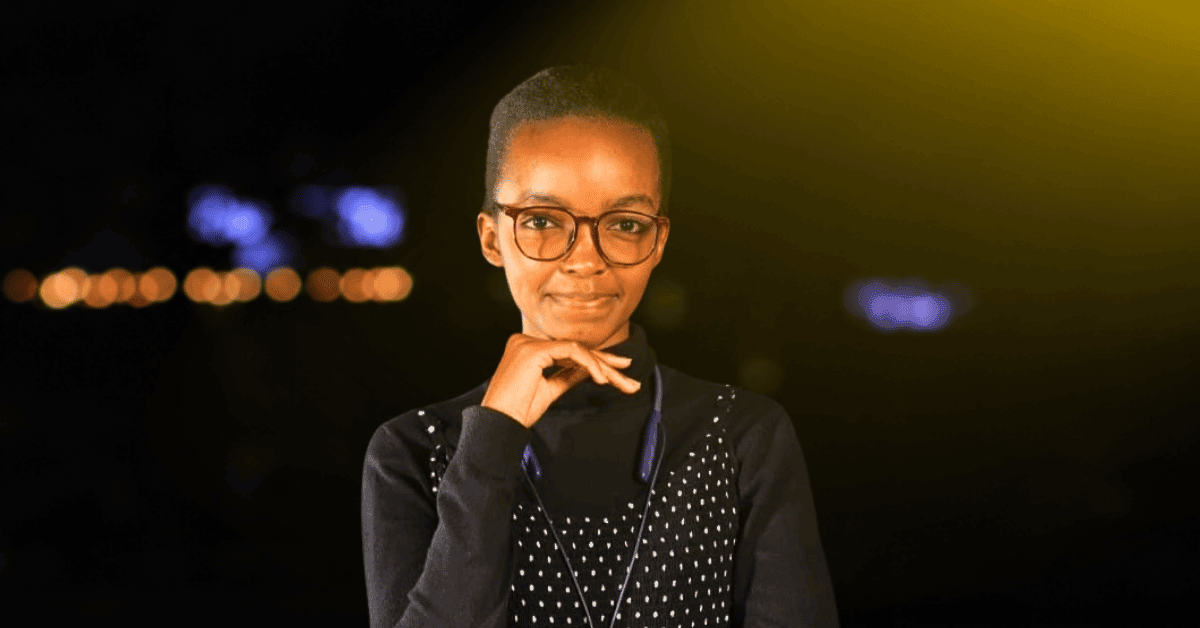
Student Ambassador spotlight: Angela Wakanyi Muguongo, Arise Campus Chapter Cohort 2.
When Angela Wakanyi Muguongo applied to become an Arise Student Ambassador in July, we asked why she was interested. Her answer wasn’t about starting a business, building a network, or adding a line to her CV.
“As a child, I used to be very confident, well-spoken, and never shying away from opportunities that felt bold,” she wrote. “Somewhere along the way, that changed. Becoming an Arise Student Ambassador is a chance for me to restore that part of me in whatever small amounts I can.”
Angela is a final-year computer science student at Dedan Kimathi University of Technology in Nyeri, Kenya, a founder in our FRP-03 cohort pathway and a Student Ambassador in the second cohort of our Arise Campus Chapter program. The cohort’s 12 weeks end with the Final Concept Showcase on November 14. Angela’s business isn’t launched yet, and some of what she set out to do as an ambassador isn’t done. Her 12 weeks are still worth telling, because they show what growth looks like before any of that is finished.
“I Was About to Politely Decline”
In September we invited Angela to speak at our “Let’s Hear From the Community” webinar, and told her she wouldn’t need to prepare a presentation. Her reply was disarmingly honest: “I’m glad you mentioned that I won’t need to prepare a presentation. I was about to politely decline.”
She said yes, even though her semester timetable hadn’t been released. When it came out, a lecture ran right up against the start of the webinar. She warned us she might be late, and joined anyway.
The Problem She’s Working On
Angela is building Awamu, a women’s underwear brand. The idea began with her own experience of not being able to find underwear that was comfortable, gave enough coverage, and stayed reliable through the day, especially during her period.
As she listened to other women, she found the problem was common, and that women were solving it in different ways.
One conversation stayed with her. A woman told her that regular underwear hadn’t worked for her, so she had switched to boxer shorts, and now has them delivered from another county because she can’t find what she needs where she lives. Nobody had to tell Angela the problem was real. This woman was already going to some trouble to solve it, and the same pattern, Angela wrote, “kept showing up again as I talked to more women.”
From “All Women” to Someone in Particular
When Angela came up for her Tier 2 Transition Review in September, the gate between validating a problem and starting to build a solution, she described her customer as “women of all ages in Kenya,” and her written submissions described a single customer conversation. That is a familiar starting point; many founders begin with a customer who is too broad. In the review itself, the panel especially appreciated hearing about the evidence she had gathered, and she passed into Build, the next stage of the curriculum.
In her mid-September check-in, she wrote that she had narrowed her customer “from ‘all women’ to a more specific group by looking deeper into the problem I’m trying to solve and the African woman’s lifestyle.”
She didn’t do that alone. Her accountability partner, Cathy Kariuki, is an FRP alumna who volunteers as a mentor in the program. They meet every two weeks. Angela credits “Miss Cathy’s prompting” for the clarity she now has about her venture. “Thanks to the team for setting up accountability partners,” Angela wrote. “I didn’t realize how much I need one.”
The revised persona is a woman of roughly 18 to 40 in urban and peri-urban Kenya, living an active life in year-round heat. She might wear a dress and want coverage underneath it, have a fuller figure and deal with chafing, or simply prefer full coverage, especially during her period. Whichever it is, she wants comfort and durability “without paying way over what she can afford.” Angela wrote that she had underestimated “how much the problem ties to body type specifically, something that only became clear once I talked to more users.”
The external judges noticed. Ambassadors’ submissions in the Arise Innovation Challenge are scored blind by a panel of outside judges, each working independently. Angela’s original Problem Statement was one of two to receive a Stage Achievement award. Her Customer Persona was the only one to receive the award at that stage.
The Gap Between Knowing and Building
Angela now understands her customer far better than she did in July, and she has a design. What she doesn’t have yet is the first product.
She doesn’t sew. Back in June she shared, “I have the design, but I don’t know where to get the material or a person to execute the design since I’m not skilled in sewing.” By October the search had narrowed to finding “a trusted tailor” to make a first version, and she is still looking. A founder can know exactly what needs to be made and still need the right skills, materials, and people to make it. In her close-out check-in, Angela named her own venture’s progress as the biggest challenge of the period.
What Angela Helped Us Learn
Our ambassadors do two jobs: their own venture work, and introducing other students to Arise. For Angela, the second has been harder, and her experience has taught us a good deal about how to support the students who come next.
The first lesson is that the program has to fit real life. Angela named time management as her biggest challenge in four of her six check-ins. Our Learning Checkpoints fall on Saturdays, which are hard for her, and she attended half of them. The students she talks to on campus raise the same concern almost every time: the program feels like too much on top of their coursework.
The second is that our participants can see things we can’t. In September Angela pointed out that our check-in form wouldn’t accept zero as the number of students reached, so an ambassador with nothing to report had to enter a number anyway. “You might want to revise this if you’re aiming to get honest and accurate responses from the ambassadors,” she wrote. Her later check-ins include several zeros.
Angela has introduced a couple of dozen students to Arise, by her own count, and we are still confirming how many have registered. When she applied, she set herself a goal of organizing meet-ups and leading other students to Arise. Through her engagement of the university’s career office, she has expanded the program’s visibility across campus and helped connect more students with the opportunity to participate.
November 14
In July, Angela joined the program hoping to recover a part of herself she felt she’d lost. In September she nearly turned down a webinar because she thought she’d have to present. On November 14 she will present her concept live to an audience and a panel of judges for about five minutes and then answer their questions: a concept shaped by what she has heard from other women, by her mentor’s prompting, and by her own willingness to change her mind.
In her close-out check-in, asked for the one goal she was most focused on, she wrote: “Preparing for the upcoming showcase.”
Her next step after that is a first version of Awamu. If you work in garment production in Kenya, or know a tailor with experience in underwear, activewear, or stretch fabrics, we’d love to hear from you. A conversation or an introduction could help Angela get from a validated problem to her first prototype. Write to us at he***@********00.org, and we’ll pass the connection on to her.
By Chudi — Founder & Convener, Africa 2100
Join the movement-follow us