

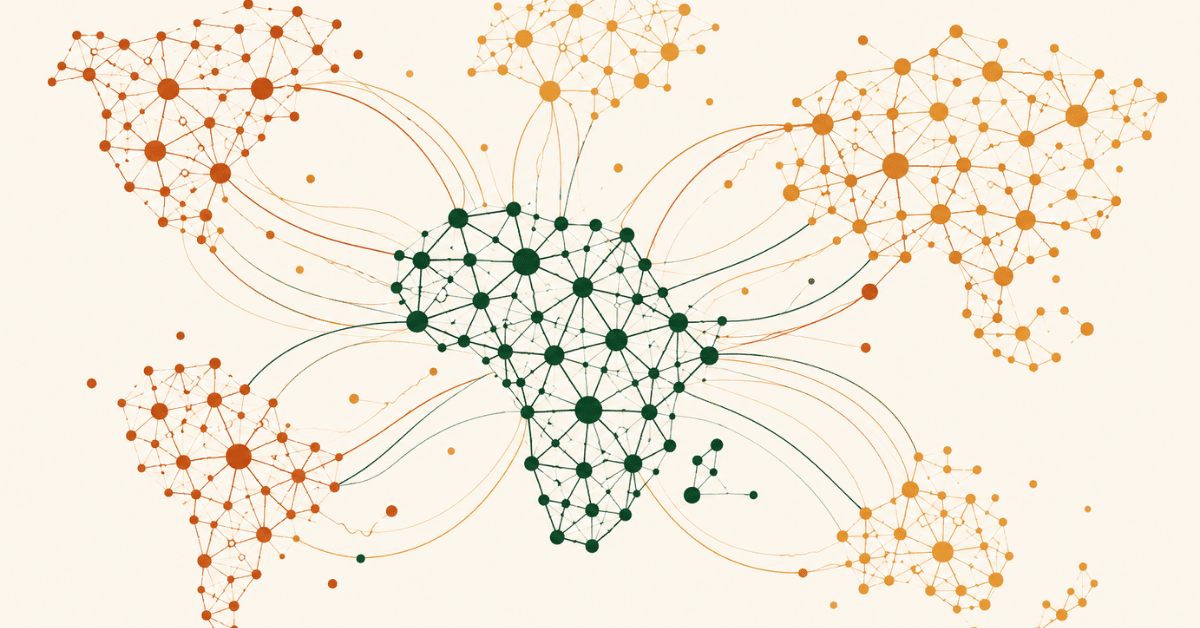
Last Wednesday, the Africa 2100 Monthly Webinar Series brought together entrepreneurs, diaspora professionals, and development advocates for a thought-provoking conversation that challenged one of the most persistent myths about the African continent: that its greatest barrier to growth is a shortage of human capital.
It isn’t.
Hosted under the theme “Africa Doesn’t Lack Talent — It Lacks Knowledge Networks,” the session offered a compelling diagnosis of why so many development models on the continent continue to fall short — and a clear, energizing vision for what it will take to change that.
The Central Argument: Talent Is Abundant. Systems Are Not.
From Lagos to Nairobi, Accra to Johannesburg, Africa is home to brilliant entrepreneurs, skilled engineers, world-class medical professionals, and one of the fastest-growing youth workforces on earth. The talent has never been in question.
What’s missing, the session argued, is the connective tissue that transforms individual talent into industrial output, scalable enterprises, and lasting prosperity: practical know-how, embedded industrial expertise, global partnerships, and access to commercial networks that sustain growth over time.
The diagnosis is precise — and it matters. Because misdiagnosing the problem leads to misallocated solutions. Billions have been invested in technology transfer across Africa. Equipment has been shipped. Facilities built. Deals signed. And yet dependency persists — because technology without embedded knowledge creates fragility, not capability. When foreign experts depart, systems stall. When spare parts are unavailable, production halts. When no local operator understands a system end-to-end, dependency replaces self-sufficiency.
The missing links are not financial. They are structural: no training infrastructure, no operational expertise, and no ecosystem support for isolated projects to sustain themselves.
Reframing Brain Drain as Brain Networks
One of the session’s most powerful reframes was on the question of brain drain. Africans rank among the most highly educated immigrant groups in the United States, United Kingdom, and Canada. Thousands of African-born professionals lead hospitals, universities, technology companies, and research institutions across the globe.
The better question, the webinar argued, is not “How do we stop the brain drain?” — it is: “How do we transform global African talent into connected African capability?”
The answer lies in brain networks. Geographic distance no longer means disconnection. Diaspora professionals can mentor startups through virtual advisory boards, deliver specialist consultations to underserved healthcare communities, upskill local practitioners through structured programs, and share operational expertise with growing industrial enterprises — all in real time, across borders, and at scale.
Talent flowing back not just as remittances, but as knowledge, mentorship, and networks. That is the model.
A Better Development Model
The session outlined an integrated capability-building approach that goes far beyond technology transfer alone:
- Technology In-Licensing — Acquiring proven global technology as a starting point
- Embedded Know-How Transfer — Experts embedded with local teams, not parachuted in and out
- Workforce Development — Training operators, technicians, and managers to own the systems
- Capital Infusion — Structured financing that enables growth rather than dependence
- Local Capability Building — Ultimately transferring ownership to African operators
The goal: every investment leaves behind greater human capacity, not greater dependency. Long-term ecosystem building, not short-term project thinking.
The session pointed to Partners in Food Solutions — a nonprofit linking companies like General Mills, Cargill, and DSM with African agri-food entrepreneurs — as a proof of concept for what sustained, embedded knowledge transfer can achieve when corporate expertise meets local entrepreneurial energy.
The Moment Is Now
Africa’s structural conditions have converged in ways that make this moment historically significant. Over 60% of Africa’s population is under 25. Rapid digital adoption is reshaping commerce, education, and service delivery across the continent. And more than 30 million African-born professionals abroad stand ready to contribute knowledge, networks, and capital to the continent’s growth.
The question is not whether Africa will grow. It will. The question is whether that growth will be powered by African capability — or by continued dependency.
What Must Happen Next
The webinar closed with a clear call to action across four priority areas:
- Diaspora Expert Networks — Formalizing and funding platforms that connect African professionals abroad with entrepreneurs and industries at home
- Industry Partnerships — Incentivizing corporations to embed technical expertise, not just capital, in African growth ventures
- Cross-Border Mentorship — Scaling structured programs that match African founders with experienced global counterparts
- Innovation Hubs & Workforce Platforms — Investing in the physical and digital infrastructure that anchors capability-building in communities
No single actor — government, funder, diaspora, or private sector — can build this alone. It requires deliberate orchestration across all dimensions simultaneously.
A Word of Gratitude: Thank You, Dr. Serge-Alain Wandji
This session would not have been possible without the generosity and brilliance of our guest speaker, Dr. Serge-Alain Wandji.
Dr. Wandji brought to the conversation not just a compelling thesis, but decades of lived experience at the intersection of healthcare, technology, finance, and African development. As the Co-Founder, President, and CEO of DiaspoCare — a digital platform enabling African immigrants to finance high-quality healthcare for relatives back home — he embodies the very model of brain circulation he advocates for. He is also Co-Founder of UzoBi, a MedTech company connecting patients and providers with clinical ethicists for ethically guided healthcare decisions.
Dr. Wandji’s presentation was lauded by attendees as “easy to follow,” “resonant,” and grounded in real-world solutions. One participant noted that his delivery challenged the audience to reckon with a simple truth: we are the solution to our problem, and we need to step up. Another called him “a very credible presenter with a strong track record of positive impact in both America and Africa.”
We are deeply grateful to Dr. Wandji for sharing his time, his insights, and his vision. The Africa 2100 community is better for it.
Join Us Next Month
The Africa 2100 Monthly Webinar Series continues each month, bringing together thought leaders, entrepreneurs, investors, and changemakers to explore the ideas shaping the future of Africa and the diaspora. Through interactive conversation, case studies, and practical insights, the series equips aspiring and early-stage entrepreneurs with the tools to build sustainable ventures — and the connections to go further.
We hope to see you at the next one.
Africa does not lack intelligence. It lacks connected intelligence. Let’s build the networks.
Join the movement-follow us